Best Air-Cooled Classics in 2026: What Independent Reviewers Actually Say
The air-cooled engine is effectively extinct in passenger cars—Porsche killed the 911’s flat-six fan in 1998, and nothing of significance has used air cooling since. That makes these machines a finite, clearly defined universe with a character you cannot replicate in anything built this decade.
Short version: The Porsche 993 is where most serious reviewers land when arguing about the best air-cooled car ever made for road use, but it costs accordingly. The VW Beetle and Citroën 2CV are the most accessible routes in, with strong communities and straightforward mechanics. For driving character on a tighter budget, the 964 Carrera is the value argument reviewers keep returning to.
The Field at a Glance
| Model | Era | Sweet Spot | Sourced from |
|---|---|---|---|
| VW Beetle | 1946–2003 | Pre-1967 or 1303 Cabriolet | Footman James, Classic & Sports Car |
| Citroën 2CV | 1948–1990 | Post-1981 front-disc models | Classic & Sports Car, Octane Magazine |
| Fiat 500 / Abarth 595 | 1957–1975 | Abarth 595 (593cc, 30bhp) | Classic & Sports Car, Footman James |
| Porsche 356 | 1949–1965 | B or C Coupé | Classic & Sports Car |
| Porsche 911 Carrera 3.2 | 1984–1989 | Low-mileage, unmodified coupé | Rennlist |
| Porsche 964 Carrera 2 | 1990–1994 | Manual, original spec | Rennlist, Repasimotorwerks |
| Porsche 993 Carrera | 1994–1998 | C2 or 4S | Rennlist, PistonHeads |
What the reviews agree on
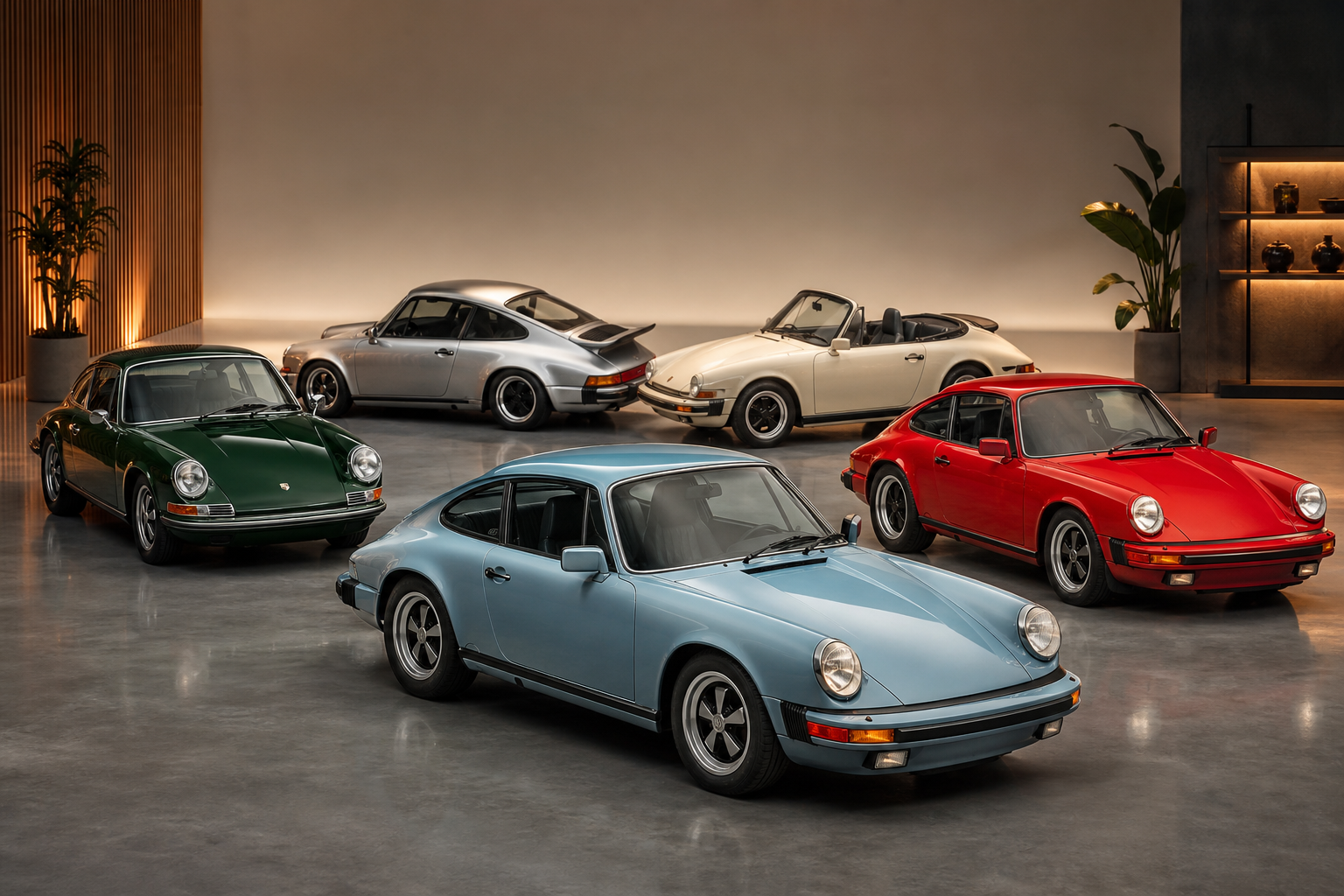
No reviewer seriously challenges the Porsche 911’s position at the top of the air-cooled hierarchy. Rennlist’s detailed three-way comparison describes the 993 as delivering “the most modern-like performance” of any air-cooled generation, while PistonHeads rates it among the few classics capable of being driven hard every day without feeling like a compromise. Classic & Sports Car, surveying the full sweep of air-cooled history, singles out the 917 racing car—producing up to 1,100bhp in turbocharged CanAm form—as “possibly the most exotic air-cooled car ever made,” though that observation is historical rather than a buying recommendation.
At the accessible end, agreement is equally firm. Footman James cites more than 21 million Beetles produced as proof of the car’s unmatched global parts network. Classic & Sports Car’s 2CV buying guide backs this up for the Citroën: the flat-twin engine is resilient enough to keep running on a single cylinder even with a broken conrod—a durability margin that says a great deal about how conservatively these units were engineered.
On what actually destroys these cars, every source aligns: rust, not mechanicals. Classic & Sports Car warns 2CV buyers that water infiltrating window seals can cause structural rot visible as misaligned or bulging body panels. Repasimotorwerks applies the same logic to the 964 and 993: a well-documented, solid example in any generation beats a rough car of a supposedly better variant. Condition first, always.
All sources also agree these cars need more routine attention than anything modern. That is either the appeal or the deterrent, depending on who is asking.
Where they disagree
The 964 versus 993 question is a genuine split. Rennlist describes the 993 as the most driver-friendly option for long-distance use—its multi-link rear axle delivering meaningfully better high-speed stability than the 964’s setup. Repasimotorwerks agrees the 993 commands a higher purchase price, but counters that the 964’s “relative affordability” has driven stronger percentage appreciation over the past five years. One source recommends the car that drives better; the other recommends the one with more room to grow. Both are right on their own terms.
Evo magazine has argued the 993’s driving experience is overrated, reportedly placing it behind the water-cooled 996 and 997 on outright dynamics. This is a minority position. PistonHeads and the Rennlist community consistently push back: because there is no water jacket absorbing noise, the air-cooled flat-six produces a richer, crisper exhaust note than any water-cooled successor, and that character is exactly what buyers are paying for. The split is real and worth knowing before committing.
The Carrera 3.2 divides opinion differently. Rennlist calls it “the lowest ownership cost” of the three main air-cooled generations, alongside “the most old school driving experience”—meaning slower, louder, and less refined than the 964’s 247bhp, 3.6-litre unit. Some buyers want that rawness. Others find the 964’s power steering and coil spring suspension make it the more usable car at comparable money.
At the budget end, Octane Magazine tilts toward the 2CV as the best first-time classic. Footman James gives equal billing to the Fiat 500. The Fiat has a credible case—the Abarth 595 variant, with 593cc, 30bhp, and around 500kg, was a genuine Mini Cooper rival in contemporary tests. But the 2CV’s extreme suspension travel and the way it corners at seemingly impossible lean angles generates a following the Fiat 500 does not quite match. Neither verdict is wrong; they reflect different priorities.
The Cars in Detail
VW Beetle
Footman James calls the Beetle one of the most popular cars in history, with over 21 million produced. Parts are cheap and globally available. The rear-engined, air-cooled layout makes engine removal for major work straightforward for home mechanics. The main threats at purchase are floor and sill rust, and a failed thermostat that can cause chronic overheating if left unattended. Simple problems; easily avoided with a proper inspection.
Citroën 2CV
Classic & Sports Car puts average examples at around £4,500, with fully restored cars reaching £15,000. The flat-twin is long-lived, but the bodywork is not forgiving of neglect. The buying guide flags Portuguese-built 2CVs from the later production run as having notably worse corrosion protection than French-market cars—worth checking at purchase. Front disc brakes arrived in 1981; post-1981 cars are meaningfully easier to service. The guide’s plain warning stands: “cheap to run doesn’t equate to cheap to restore.”
Fiat 500 and Abarth 595
Classic & Sports Car is candid: the original 479cc engine “was no ball of fire.” The Abarth 595—593cc, 30bhp, around 500kg—is where the car earns its reputation. Contemporary tests put it against the Mini Cooper, and it held its own. The 695 variant pushed output to 40bhp. At these power-to-weight figures, those numbers mean something real.
Porsche 356
Classic & Sports Car places the pinnacle here as the Carrera 2: a 2.0-litre quad-cam engine producing 130bhp in a sub-tonne car, capable of 125mph in early 1960s trim. Entry-level pricing for any clean 356 is now firmly in serious collector territory. Ferdinand Porsche drew the architecture directly from the Beetle platform; the 356 refined it substantially before the 911 broke free of it entirely.
Porsche 911: Which Generation?
Repasimotorwerks found the 993’s M64 engine “remarkably reliable,” citing many examples past 150,000 miles in good mechanical health. The 964 is the trap: high ownership costs and a history of neglect when values were low means finding a clean car takes real effort. Rennlist’s overall verdict applies across all three generations: “buy the best example you can afford.” A well-documented 964 at a fair price beats a tired 993 at the same money, every time.
FAQ
Which air-cooled 911 generation is the best value in 2026?
It depends on what value means to you. Repasimotorwerks notes the 964 has shown stronger percentage appreciation than the 993 over the past five years and still carries a lower entry price. But Rennlist’s analysis shows 964 ownership costs run the highest of the three main generations—it is not a cheap ownership proposition, just a potentially better investment. The 993 costs more to acquire but less to run day-to-day.
Are air-cooled classics practical for regular use?
The Beetle and 2CV were designed as daily transport and remain functional as such—Footman James and Classic & Sports Car both confirm the mechanics are durable when maintained. Repasimotorwerks cites many 993 engines past 150,000 miles in good mechanical condition. The consistent caveat across all sources: these cars need more routine attention than anything modern, and deferred maintenance compounds quickly.
What is the most common buying mistake?
Trusting the engine while ignoring the body. Classic & Sports Car’s 2CV guide warns that cheap examples often hide structural rust beneath fresh underseal and new paint—and that the same trap catches Beetle buyers. For Porsches, Rennlist specifically flags the 964 generation: finding a genuinely well-maintained example is harder than it looks, because many were neglected when values were low a decade ago.
Is the Citroën 2CV or VW Beetle the better first classic?
Octane Magazine leans toward the 2CV for simplicity and community support. Footman James rates both equally, with particular emphasis on the Beetle’s global parts network. Classic & Sports Car puts average 2CV prices at around £4,500—somewhat lower than comparable Beetles—and the flat-twin has fewer moving parts than the Beetle’s flat-four. For buyers in North America, the Beetle has a substantially larger local aftermarket.
Why did air-cooled engines disappear from production cars?
Emissions and noise regulations made them increasingly difficult to certify, particularly in the US and Europe. Water cooling gave manufacturers more displacement headroom and made meeting stricter standards practical. Porsche’s switch with the 996 in 1998 was the last major casualty in the passenger-car world. PistonHeads has documented the owner reaction to that decision across decades of forum discussion—the debate has not quieted in the 28 years since.
Sources
- classicandsportscar.com
- footmanjames.co.uk
- rennlist.com
- classicandsportscar.com
- repasimotorwerks.com
Related Articles