
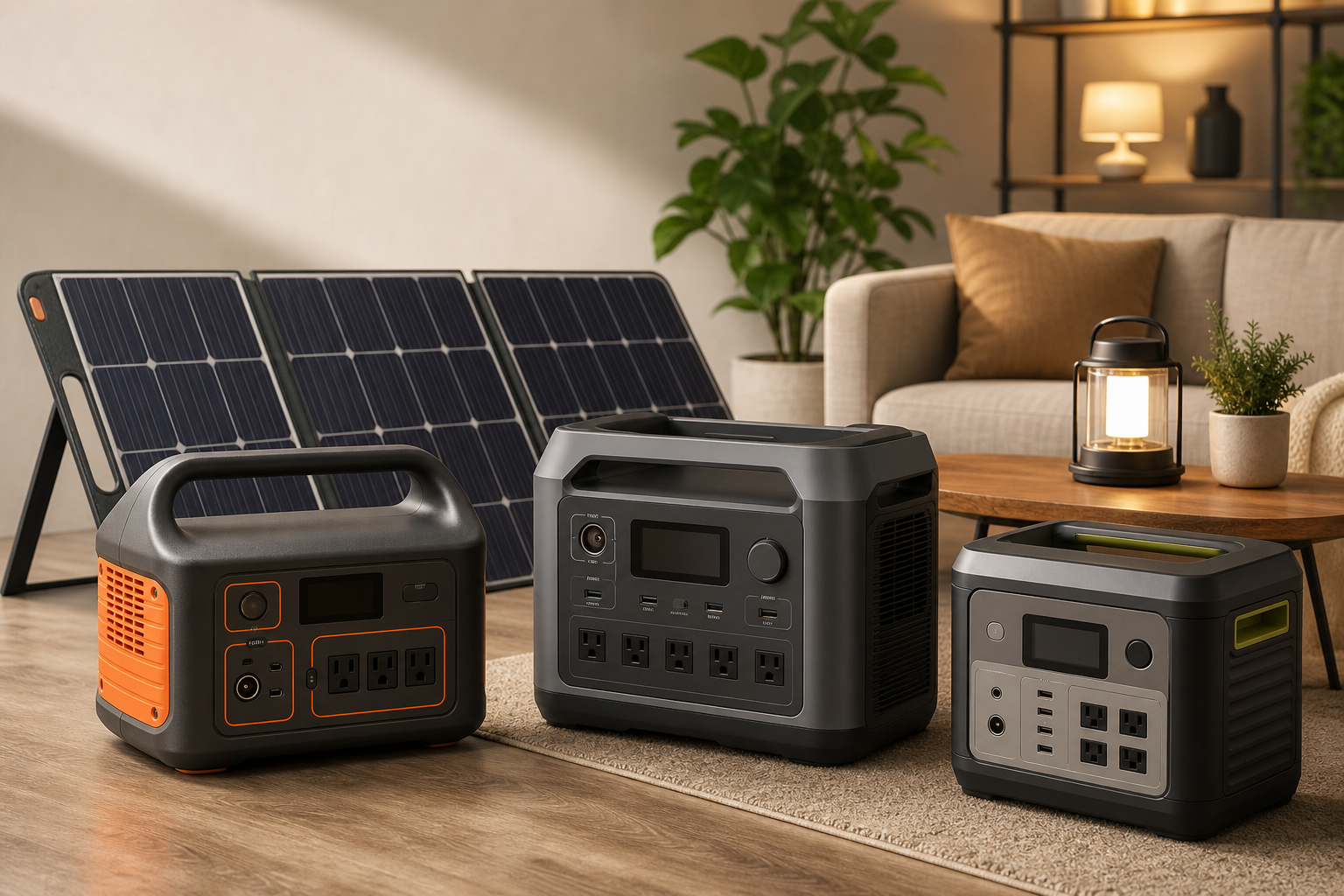
Choosing the Best Solar Generator for Home Backup: Jackery vs. Bluetti vs. EBL
Choosing the Best Solar Generator for Home Backup: Capacity, Chemistry, and Real-World Performance
When a power outage hits, you need to know what will actually power your home. The three generators you’re considering—Jackery, Bluetti, and EBL—all show up in forums and reviews for good reason, but they’re built for different situations. Understanding the real differences helps you pick the one that matches your actual needs instead of what looks good on spec sheets.
Power Requirements for Essential Home Devices
Before comparing brands, you need to know how much power you’re actually trying to run. A refrigerator is the toughest part of your list. Most modern fridges draw 100–300W while running, but they need 1000–2000W or more just to start the compressor—that surge is where many people’s generators fall short. Add in a Wi-Fi router (20W), LED lights (15W each), phone chargers (10W), and you’re at maybe 500–700W steady-state. But if you run the fridge plus a microwave or space heater, you spike much higher very quickly.
The practical minimum for your use case: a generator with at least 2000W continuous output and 3000W+ peak capacity. A 2500Wh battery lets you run a fridge for roughly one full day without solar recharging. For extended outages, you’d want 5000Wh or more, or plan to recharge with solar panels every afternoon.
Battery Chemistry Matters More Than You Think
Both Jackery and Bluetti have shifted to LFP (Lithium Iron Phosphate) batteries in their premium lines, and this matters for durability. LFP batteries survive 10–15 years and 3000–6000 full charge cycles before dropping to 80% capacity. They’re stable, resist thermal runaway, and handle partial discharge better than older lithium-ion. Temperature affects them—every 10°C rise above 25°C cuts cycle life nearly in half—but in a home backup context, you’re storing them indoors at room temperature anyway.
Jackery’s newer Explorer Plus line and Bluetti’s most popular models both use LFP now. EBL units still use lithium-ion in many models, which is fine for shorter expected lifespans but matters if you plan to rely on this for 10+ years. The warranty length and capacity fade specs tell you what the manufacturer expects: Bluetti typically warrants LFP units for 10 years, Jackery for 5–7 depending on the model, and EBL for 2–3.
Inverter Quality and Charging Speed
All three brands use pure sine wave inverters—that’s now standard. The difference is in MPPT (solar input) capacity and AC charging speed. Bluetti’s AC models have higher MPPT capacity, meaning they recharge faster from solar. An AC300 can accept 1200W of solar input per MPPT (two available), while Jackery typically caps out around 500W solar input. This matters if you’re planning to recharge after an outage: Bluetti will recover faster on a cloudy day or with fewer panels.
AC charging speed varies wildly. Some units take 13+ hours from a wall outlet, others do it in 90 minutes. Jackery and newer EcoFlow units lean fast; Bluetti’s larger models trade charging speed for capacity. If you plan to keep the generator topped off regularly, check the AC input wattage in the specs.
Brand-by-Brand Breakdown
Jackery: Strength is simplicity and portability. Jackery generators tend to be lighter and easier to move around. The 2000 Plus and 3000 Plus models handle residential backup reasonably well—3000W output, expandable batteries, and they’ll run a fridge plus some essentials. The 3600 Plus adds 120V/240V dual output, which matters if you want to run heavy appliances later. Downside: smaller MPPT limits solar recharging unless you buy a lot of panel capacity.
Bluetti: Built for capacity and expandability. Bluetti units are heavier but offer more power and battery options. The AC300 stacks with B300 batteries to reach 15kWh+ very easily. Strongest MPPT in the consumer market means fastest solar recovery. Better long-term warranty. Downside: pricier per watt-hour, and the weight makes them less portable if you ever need to move the whole system.
EBL: The budget entry. EBL’s 1000W model is cheap and has the most output port variety. Good for occasional camping or light backup. For serious home outage duty, it’s underpowered—1000W peak won’t start most refrigerators, and 1000Wh runs them for maybe 4–5 hours maximum. You’d need multiple units or very consistent solar input to make it work for what you’re describing.
Sizing for Your Specific Use Case
You want fridge, router, lights, phone chargers, and occasional small appliances. That’s roughly: 2000W+ continuous capacity and 4000–5000Wh battery minimum. If this is truly backup for outages, budget 2–4 solar panels (400–800W total) to recharge in a single day. Without solar, a 5000Wh battery runs everything for 6–8 hours max, then you’re waiting for a recharge or pulling from the grid again.
Bluetti’s AC300 with one B300 battery hits these numbers and scales up easily later. Jackery 3000 Plus is close but needs careful panel selection for solar recharging. EBL falls short unless you accept that it’s a short-term backup, not a multi-day solution.
Durability and Long-Term Value
Over 5–10 years, an LFP-based system with good warranty backing costs less per day of use. Bluetti’s warranty and documentation around degradation is more transparent. Jackery is catching up with LFP adoption but still offers shorter warranties on some models. Real-world reports from Reddit threads and homeowner forums generally show Bluetti lasting longer with less capacity fade, but both brands are reliable if you stay within their operating temperature range and don’t run the battery all the way to zero regularly.
Portability matters less for home backup than for camping, so don’t let Jackery’s lighter weight override better capacity-per-dollar if you’re planning to leave it in a garage or utility room. That said, if you think you’ll move it between locations—basement to garage, home to cabin—Jackery’s weight advantage adds real value.
Sources
- solarparadise.com
- portablepowerlab.com
- popsci.com
- cnn.com
- ecoflow.com
- jackery.com
- ankersolix.com
- solarreviews.com