Best Affordable Muscle Cars in 2026: What Reviewers Actually Found
The muscle car market in 2026 looks nothing like it did five years ago. The Chevrolet Camaro is discontinued — no 2026 model exists. The Dodge Challenger wrapped production in late 2023. New-car shoppers now face two choices: the Ford Mustang or Dodge’s freshly returned gas-powered Charger. The discontinued models haven’t vanished, though — they’ve moved to used lots, often at prices that make the new hardware look expensive. Here’s what independent reviewers and long-term owners actually found when they drove all of it.
The short version: The Ford Mustang EcoBoost, starting around $32,640, is the accessible new-car entry point most outlets recommend. The Mustang GT at ~$46,560 is where reviewers say the V8 magic starts. The Dodge Charger Sixpack — now powered by a twin-turbocharged inline-six rather than the V8 it replaced — starts near $50,000 and divides opinion hard. The best value in the whole segment may be used: a 2016–2020 Camaro SS or a 2015–2018 Challenger SRT 392 can be found for $25,000–$38,500, delivering more horsepower for the money than anything new at those prices.
The New-Car Field
Ford Mustang EcoBoost (~$32,640)
The turbocharged 2.3-liter four-cylinder makes 315 hp and 350 lb-ft of torque. Edmunds’ testing puts the automatic at 5.6 seconds to 60 mph. The EPA rates it 22 city/33 highway mpg — numbers the Charger can’t approach. CarBuzz scores the Mustang lineup 8.0 out of 10 and lists the EcoBoost coupe from $32,320. The rational case writes itself: you get the Mustang’s looks, technology, and handling at a price that undercuts the nearest V8 muscle car by roughly $14,000. The emotional case is harder to make. Chasing Cars’ extended time with the V8 GT implicitly makes the counterargument — several reviewers note the EcoBoost sounds and drives like a different category of car entirely.
Ford Mustang GT (~$46,560)
The 5.0-liter Coyote V8 produces 480 hp. Edmunds clocked the automatic at 4.3 seconds to 60. Chasing Cars ran a long-term test on the 2026 GT Fastback and scored the manual-gearbox version 8 out of 10, calling its six-speed “one of the most fluid, easy-to-select and satisfying manuals” in the segment. The automatic earned a 7.5 — reviewers noted gear-hunting under hard acceleration as a recurring irritant. Boot space measures 381–408 liters, which is practical for a two-door coupe. Real-world fuel use came in at 15.3L/100km in Chasing Cars’ hands (~18 US mpg), something to factor into ownership costs. Ford made no significant mechanical changes for 2026; this is the redesigned 2024-generation car carried forward.
Dodge Charger Sixpack (~$50,000–$57,000)
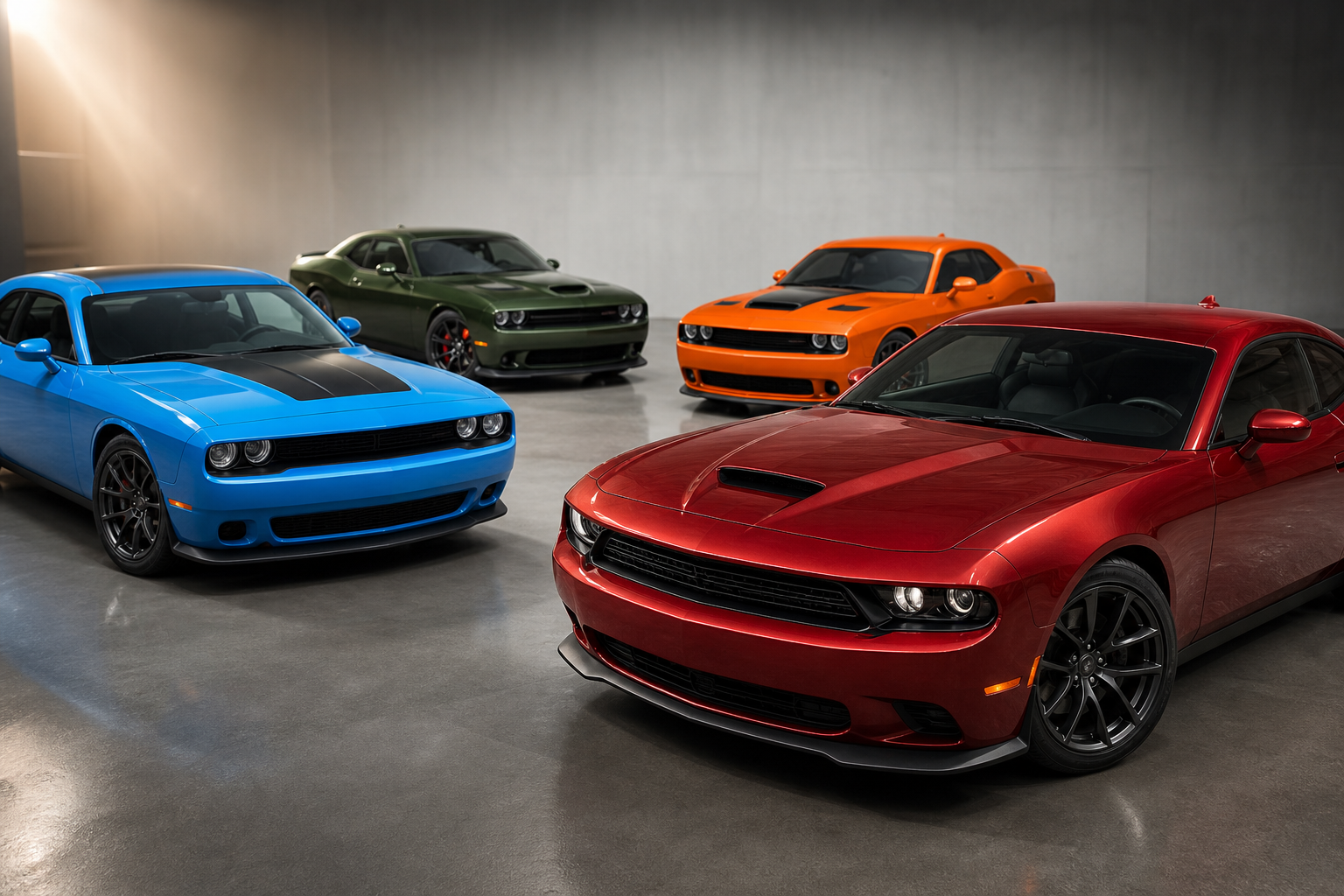
No V8. Dodge’s “Hurricane” twin-turbo 3.0-liter inline-six produces 420 hp in the base R/T and 550 hp in the Scat Pack. Cars.com gave the Charger a strong rating, praised its “strong, refined powertrain” and launch-control drag-racing technology, and confirmed 3.9 seconds to 60 mph for the Scat Pack. The R/T starts at $49,995; the Scat Pack coupe opens at $56,990. CarBuzz rates the Charger Daytona lineup — which encompasses the gas Sixpack — 8.4 out of 10, one point ahead of the Mustang, and identifies the 550 hp Six-Pack as the pick for combustion-engine buyers. The car comes standard with AWD and seats five. Where nearly every reviewer lands the same punch: the exhaust note. Cars.com called it “underwhelming,” and that same criticism surfaced across multiple other road tests. The engine is genuinely fast. It does not sound like a muscle car.
The Used-Market Case
No new muscle car below $46,000 has a V8 right now. The used market fills the gap. CarBuzz identifies a 2016–2020 Chevrolet Camaro SS — 455 hp LT1 V8, particularly strong with the 1LE handling package — priced from $28,500 to $38,500. A 2015–2018 Dodge Challenger SRT 392 with 485 hp from a naturally aspirated 6.4-liter HEMI runs $25,500 to $35,500. MotorBiscuit pushes further up the performance ladder: a fifth-generation Camaro ZL1 with 580 hp from a supercharged V8 lands around $38,000, making it arguably the highest horsepower-per-dollar proposition in this entire roundup. For buyers on a tighter budget, MotorBiscuit notes an S550 Mustang GT (2015-onward) can be found at the lower end of the mileage spectrum for under $20,000.
HotCars makes the starkest case: a 2009–2010 Dodge Charger R/T is available for $8,000–$12,000, delivers 368 hp from a 5.7-liter Hemi V8, and earned a 4.6-out-of-5 reliability rating from 839 owners surveyed by KBB. They flag the known “Hemi Tick” camshaft wear issue and recommend a cold-start inspection before committing. Money Digest puts the 2013 Challenger R/T at $15,322 as a credible floor for anyone who wants a muscle car nameplate without a major outlay.
The catch, as MotorBiscuit notes directly: the window for cheap late-model muscle has mostly closed. Challenger R/T Scat Packs that traded as bargains in 2023 now hover around $30,000 as collector demand absorbed the discontinued supply.
At a Glance
| Model | Type | Price (approx.) | Power | 0–60 mph | Sourced from |
|---|---|---|---|---|---|
| Ford Mustang EcoBoost | New | ~$32,640 | 315 hp (turbo 4-cyl) | 5.6 sec | CarBuzz (8.0/10), Edmunds |
| Ford Mustang GT | New | ~$46,560 | 480 hp (5.0 V8) | 4.3 sec | Chasing Cars (8/10 manual), CarBuzz, Edmunds |
| Dodge Charger R/T Sixpack | New | ~$49,995 | 420 hp (twin-turbo I6) | ~4.5 sec (est.) | Cars.com, CarBuzz (8.4/10) |
| Dodge Charger Scat Pack Sixpack | New | ~$56,990 | 550 hp (twin-turbo I6) | 3.9 sec | Cars.com, CarBuzz (8.4/10) |
| 2016–2020 Chevrolet Camaro SS | Used | $28,500–$38,500 | 455 hp (LT1 V8) | ~4.0 sec | CarBuzz, MotorBiscuit |
| 2015–2018 Dodge Challenger SRT 392 | Used | $25,500–$35,500 | 485 hp (6.4 HEMI V8) | ~4.2 sec | CarBuzz, MotorBiscuit |
| 5th-gen Chevrolet Camaro ZL1 | Used | ~$38,000 | 580 hp (supercharged V8) | ~3.8 sec | MotorBiscuit |
What the Reviews Agree On
- The Mustang GT is the best new-car V8 value. CarBuzz, Chasing Cars, and Edmunds all flag the GT as the trim worth having. The EcoBoost is a legitimate budget entry; reviewers consistently say the V8 justifies the premium for anyone who cares about the driving experience.
- The Charger Sixpack’s exhaust note is a consistent complaint. Cars.com called it “underwhelming”; that word appears in various forms across nearly every review. The engine is strong. It sounds nothing like a traditional V8 muscle car.
- The used market is genuinely compelling. CarBuzz, MotorBiscuit, and HotCars all make the case that discontinued Camaros and Challengers offer more horsepower per dollar than new cars in the same price window.
- The Charger serves a different purpose than the Mustang. Cars.com and CarBuzz both describe it as better at highway cruising and straight-line work than precision cornering — a grand-touring machine dressed as muscle.
Where They Disagree
The sharpest split is over the Charger Sixpack’s overall value proposition. Cars.com came away impressed with its powertrain refinement and all-weather capability, giving it a strong score. CarBuzz’s 8.4 rating puts it ahead of the Mustang on balance. But Edmunds’ spec comparison concluded the Mustang GT delivers more per dollar for a driver who wants engagement, pointing to the available manual gearbox and sharper chassis as advantages the Charger cannot answer. The Charger has no manual option at all — a dealbreaker for some, irrelevant to others.
There’s also a genuine split over whether the Sixpack counts as a real muscle car. A Girls Guide to Cars framed the debate directly and found no consensus — the performance numbers qualify; the powertrain character arguably does not. CarBuzz treats the inline-six as a reasonable evolution; multiple road tests describe an engine note that sounds more like a European sport sedan than anything American. Both reactions are honest. They reflect different definitions of the category.
The used-versus-new debate doesn’t produce a single answer either. HotCars and MotorBiscuit push hard toward used, arguing more horsepower for less money. CarBuzz is more measured: late-model Challenger and Camaro prices rose sharply after production ended, and buyers expecting 2022-era deals will find a tighter market. The calculus depends on whether warranty coverage and known costs matter more than maximizing horsepower for the money.
Finally, opinions on the EcoBoost break along practical versus enthusiast lines. Edmunds treats it as a fully capable, fairly priced entry into the Mustang family. Chasing Cars’ long-term GT account makes the V8 case implicitly — spending time with the real thing makes the four-cylinder feel like a compromise. Neither is wrong.
FAQ
Is the Ford Mustang EcoBoost worth buying over the GT?
For buyers where budget is the deciding factor, yes — CarBuzz lists it from $32,320 with 315 hp and 33 mpg highway. For anyone prioritizing driving experience, most reviewers say stretch to the GT. Chasing Cars found the V8 manual combination was reason enough on its own to pay the difference.
Is the Dodge Charger Sixpack a better buy than the Mustang GT?
It depends on your priorities. The Scat Pack hits 3.9 seconds to 60 per Cars.com testing and adds AWD, five seats, and a four-door option that the Mustang doesn’t offer. But it starts $3,000–$10,000 more than the Mustang GT depending on trim, has no manual gearbox, and draws consistent criticism for its exhaust note. CarBuzz rates it higher overall (8.4 vs 8.0); Edmunds and Chasing Cars favor the Mustang for driver engagement. The Charger wins on practicality and straight-line pace. The Mustang wins on feel.
What’s the best used muscle car under $30,000 in 2026?
CarBuzz identifies the 2015–2018 Dodge Challenger SRT 392 — 485 hp HEMI V8, naturally aspirated — from $25,500 as a strong buy. A same-era S550 Mustang GT starts around $25,000 and offers sharper handling. Both MotorBiscuit and CarBuzz also flag the 2016–2020 Camaro SS, particularly the 1LE package, as one of the most capable used muscle cars available at this price point.
Does the 2026 Dodge Charger Sixpack offer a manual transmission?
No. The Sixpack pairs its twin-turbo inline-six with an eight-speed automatic only. The 2026 Mustang GT comes with a six-speed manual as standard. Edmunds flagged this directly in its Mustang-versus-Charger comparison — for any buyer who wants to row their own gears, the choice is already made.
Is the Chevrolet Camaro coming back?
Not as a 2026 model. GM ended sixth-generation Camaro production after the 2024 model year with no confirmed successor. MotorBiscuit notes this is already driving appreciation in SS and ZL1 examples — supply is fixed, and enthusiast demand has moved prices up since the announcement. The remaining inventory is not getting cheaper.
Sources
Related Articles