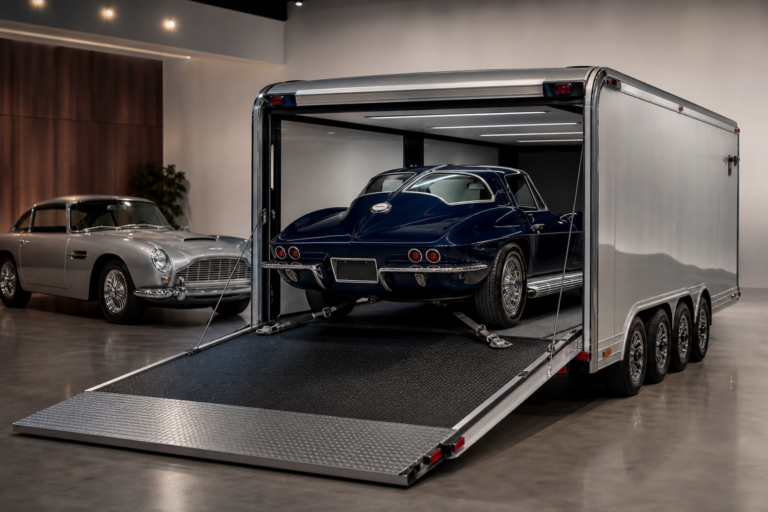
Best Car Storage Solutions for Collectors in 2026: What the Experts Actually Recommend
If you’ve spent years tracking down the right car, losing it to rust, condensation, or a concrete floor’s moisture vapor is the worst possible ending. Storage isn’t exciting — but it’s where collections either survive or slowly rot.
Short version: For home garages, the BendPak HD-9 four-post lift is the consensus pick across multiple 2026 review sources. For in-place climate protection, the PermaBag system currently holds stronger independent credentials than CarCapsule. No suitable home garage? The choice narrows to a commercial climate-controlled unit ($150–$400/month) or a garage condo — one rents space, the other builds equity.
What the reviews agree on
Four-post lifts over two-post, full stop. Car Lift Lab explains the reason directly: two-post arms concentrate load on pinch welds and suspension components, which degrades both over months of continuous storage. Four-post runways spread weight across the full wheelbase — the way a parked car actually wants to sit. Long-term storage on two-post arms is a slow way to damage the vehicle you’re trying to preserve.
Ceiling height is math, not preference. Car Lift Lab sets the floor at 10 feet for sedan-over-sedan stacking, 12 feet or more for trucks on top. Buy the wrong lift for your ceiling and you have an expensive ramp, not a stacking solution. Standard 8-foot ceilings cannot stack two full-size vehicles under any circumstances.
Climate control isn’t optional for serious preservation. Osprey Storage identifies humidity as “the silent killer of vintage steel,” and American Collectors Insurance echoes the accepted targets: 50–70°F with 40–60% relative humidity. Both sources flag unheated standard storage units as appropriate only for short-term storage of mechanically robust vehicles — not classics with original metal, chrome, or leather.
Smart battery maintainers, not basic trickle chargers. Multiple sources converge on the Battery Tender Plus and NOCO GENIUS10 (around $100) for their automatic float mode, which monitors voltage and prevents overcharge. A dumb trickle charger running continuously for six months can damage a battery. A smart maintainer won’t.
Installation costs are real and routinely buried in headline prices. Car Lift Lab adds $500–$3,000 for professional fitting plus $200–$500 for dedicated electrical work to any base lift price. The BendPak HD-9’s $2,899 sticker can realistically land at $4,500–$5,800 all-in, depending on your electrical panel and who installs it. Budget for the full number before committing to a model.
Specialist insurance is non-negotiable. American Collectors Insurance makes a point most storage content ignores: standard self-storage policies commonly cap vehicle coverage at as little as $5,000. That is useless for anything worth collecting. Dedicated collector car coverage from a specialist insurer should be confirmed before signing any storage agreement — not after.
The main options at a glance
| Solution | Best For | Approximate Cost | Key Limitation | Sourced From |
|---|---|---|---|---|
| BendPak HD-9 (4-post) | Most home collectors — storage and light service | $2,899–$3,800 | Needs 11–12 ft ceilings for stacking; bridge jacks add $500–$1,000 | Car Lift Lab, Car Lift For Garage |
| Triumph NSS-8 (4-post) | Budget pick for standard passenger cars | $1,799 | ETL certified only (not ALI); 8,000 lb cap | Car Lift For Garage |
| BendPak HDS-14 (4-post heavy duty) | Truck and large SUV collectors | $5,500–$7,000 | Large footprint; needs a solid concrete slab | Car Lift Lab, Car Lift For Garage |
| BendPak PLB9X (parking lift) | Low-ceiling garages where 4-post stacking won’t fit | $8,500+ ($10,000–$15,000 installed) | Parking only — no service access whatsoever | Car Lift For Garage |
| QuickJack BL-5000SLX (portable) | Renters; no permanent installation needed | $1,400–$1,600 | 5,000 lb limit; not for vertical stacking | Car Lift Lab |
| PermaBag (climate-sealed cover) | In-place moisture protection without electricity | Contact manufacturer | PermaPack cylinders require periodic regeneration | AutoPyjama; Motor Klassik Best Brand 2026 |
| Commercial climate-controlled unit | Collectors without a suitable home garage | $150–$400/month | No equity built; access often limited to business hours | GearJunkie, Osprey Storage |
Where they disagree
BendPak vs. Rotary: is the price gap justified?
My Garage Supplies puts BendPak four-post lifts at $3,500–$9,000 and Rotary at $5,000–$12,000+. Rotary manufactures in the USA; BendPak sources steel globally. BendPak ships with a five-year structural warranty versus Rotary’s two years on parts and one year on labor — a meaningful gap on paper. Owner threads on Grassroots Motorsports and the Antique Automobile Club of America forums show BendPak units running without fault for over a decade in private garages, making the premium difficult to justify for residential use. My Garage Supplies also notes that brands like Atlas “deliver similar lifting power” at lower cost than either. The Rotary argument — faster service, deeper dealer network — lands better in a commercial shop than a three-car home garage. No reviewer surveyed names Rotary the obvious choice for private collector use.
CarCapsule vs. PermaBag: the moisture problem
CarCapsule invented the inflatable-enclosure category in 1991: a sealed PVC bubble held up by a continuously running filtered fan that maintains positive air pressure, keeping out dust and pests. Owners on the Mid-Engine Corvette Forum largely report clean long-term results, but a documented thread raises a concrete problem — as a garage cools overnight, car surfaces cool faster than the trapped air inside the capsule, producing condensation on paint and bare metal. The opposite of the intended outcome, and a meaningful concern in climates with temperature swings.
PermaBag approaches the problem from the other direction: an airtight bag sealed with a diver’s zipper, using PermaPack stainless cylinders to passively adsorb moisture with no electricity required. AutoPyjama claims it holds internal humidity below 50% even below 10°C — a condition where CarCapsule’s fan system reportedly underperforms. PermaBag won Motor Klassik’s Best Brand Award for 2026, its 19th consecutive year, and Best Product from Classic & Sports Car magazine in the UK. That is more independent specialist-press validation than CarCapsule currently holds. The trade-off is real: PermaPack cylinders need periodic regeneration, while CarCapsule is genuinely plug-and-forget once powered.
The storage facility cost math
GearJunkie pegs commercial storage at $45–$450 per month and cites specialist facilities like Westside Collector Car Storage in Los Angeles and Portland Motor Club in Maine as examples of the high-service tier, where concierge maintenance, climate monitoring, and transport coordination are available. Luxe Dream Garage runs the long-term numbers harder: premium warehouse storage at $1,500–$3,500 per month totals up to $420,000 over a decade with zero equity built. A garage condo at $200–$500/month in HOA fees builds ownership and, per Luxe Dream Garage, can appreciate 3–7% annually in supply-constrained markets. One specific claim from that source — that collections in precision climate control “appreciate 15–20% faster” — appears without a third-party citation, so treat it as directional rather than verified data.
To run the engine periodically, or not
American Collectors Insurance states that most experts consider periodic running beneficial for post-1950s stored cars — the recommended cycle includes reaching full operating temperature, exercising HVAC, and moving the vehicle. Some long-term preservation advocates push back: a cold start that never reaches operating temperature deposits varnish and introduces condensation, doing more harm than good. The reviewed material doesn’t resolve this cleanly. The most defensible read is that it depends on storage duration and ambient conditions — a car stored over a single winter in a temperate garage likely benefits from a monthly warm-up; a decade-long preservation project in a sealed, controlled environment may not.
FAQ
What ceiling height do I need for a car stacking lift?
Car Lift Lab sets the minimum at 10 feet for sedan-over-sedan stacking, 12+ feet if a truck-sized vehicle goes on top. Standard 8-foot ceilings rule out stacking entirely. A dedicated parking lift like the BendPak PLB9X can function in a 9-foot garage, but costs $10,000–$15,000 installed and provides no access for service work underneath.
Do four-post lifts need to be bolted to the floor?
Most models, including the BendPak HD-9, operate under load without permanent anchor bolts, though anchoring is recommended. Car Lift For Garage emphasises that concrete quality matters more than bolting: a 4-inch reinforced slab is the standard baseline, and cracked or weak concrete must be fixed before installation, not after the lift arrives.
Is climate control always necessary for stored collector cars?
Osprey Storage draws a clear line: active humidity management is required for original interiors, bare metal, chrome trim, and any storage exceeding three months. Standard unheated units can work for durable vehicles over a single mild-climate season, but the damage window opens quickly beyond that — rust, dry rot, and gasket cracking don’t announce themselves until the car comes out of storage.
What is the difference between a battery tender and a trickle charger?
A basic trickle charger runs continuously without monitoring voltage, and can overcharge and permanently damage a battery over months. A smart maintainer like the Battery Tender Plus or NOCO GENIUS10 monitors charge state and shifts to float mode when full, making indefinite connection safe. Every source reviewed on this point agrees: use a smart maintainer for any storage lasting more than a few weeks.
Can a standard self-storage facility cover my collector car at full value?
American Collectors Insurance specifically flags this gap: general-purpose self-storage policies commonly cap vehicle coverage at $5,000 per vehicle. For any car of real collector value, that is inadequate. Dedicated collector car coverage from a specialist insurer is the right solution — and should be in place before the car goes into storage, not arranged afterward.
Sources
- carliftlab.com
- carliftlab.com
- carliftforgarage.com
- mygaragesupplies.com
- autopyjama.com
- gearjunkie.com
- americancollectors.com
- ospreystorage.com
Related Articles